


Abstract
Over the past year, ‘digital sovereignty’ has become an increasingly familiar concept in Brussels and many European capitals. The geopolitical implications of the technological infrastructure underpinning our economies and social systems have moved to the forefront of the political debate. Yet according to a representative survey conducted by the Bertelsmann Stiftung in June 2026, the term itself remains unfamiliar to many European citizens, even though they have a solid understanding of the issues behind it. While only 49% of respondents across Europe say they are familiar with the term ‘digital sovereignty’, many have clear expectations about what it should entail. Nearly three-quarters (72%) of respondents want Europe to have control over key digital technologies and infrastructure, while 73% are concerned that critical European services could be remotely disabled by actors outside Europe – the so-called kill switch scenario. The findings therefore point to broad support for the underlying objective of greater European digital sovereignty, even if the term itself and the narrative surrounding it have yet to resonate with everyone.
Support for greater European control does not map onto the political spectrum equally. It is strongest in the political centre, while falling sharply on the far right. Across Europe, only 41% of respondents on the far right consider European control important, and just 35% would switch to European alternatives. What most respondents share, however, is a desire for concrete action and a clear strategy: transparency in digital systems used by public institutions (83%), robust legal remedies in the event of system failures (78%), and the storage and processing of data in Europe (69%). Taken together, the results suggest that support for digital sovereignty is concentrated in the political centre and that Europeans expect meaningful safeguards, while remaining unconvinced that Europe currently provides them to a sufficient degree.
The survey also reveals that public support for digital sovereignty should not be interpreted as a choice between technological capacity and regulation. While a majority of Europeans remain unconvinced by Europe's regulatory performance to date, they nevertheless support developing new European technological capabilities and by no means reject further effective regulation. Rather than viewing these approaches as opposites, respondents regard technological capacity and effective regulation as complementary elements in reducing digital dependencies.
This policy brief emphasises that European alternatives should not merely replicate the centralized, proprietary hyperscaler paradigm that created today's dependencies. A European response built on the same logic, with a handful of dominant, closed platforms, would exchange one form of dependency for another. Instead, Europe's comparative advantage lies in digital commons, interoperable and federated systems, and decentralized infrastructures whose resilience derives from not having a single point of failure. The development of a compelling narrative and accessible terminology to communicate this publicly backed vision is a tangible opportunity for decision makers.
Key Findings
Half of Europeans are unfamiliar with 'digital sovereignty' – yet nearly two-thirds support its underlying principles. While 51% of EU respondents are unfamiliar with the term, 72% consider it important for Europe to have control over key digital technologies. The gap between awareness of the term and support for the principles behind it points to a major communication challenge for policymakers.
Willingness to switch to European alternatives is widespread but conditional. Two-thirds (67%) would prefer European alternatives to the AI, social media and cloud services they currently use, provided they offer comparable performance. This is the only question in the survey for which there are no substantial age-related differences at the European level.
Transparency commands particularly strong support. Overall, 83% of European respondents consider it important that digital systems used in healthcare, elections or the justice system are transparent and secure. That figure rises to 94% in Sweden and 89% in Poland.
Support is strongest in the political centre, not on the nationalist right. Support for European control is weakest on the far right (41%) while reaching 79% among centre-left respondents. The findings suggest that support for digital sovereignty is concentrated around the political centre rather than being primarily associated with nationalist positions.
Older Europeans are less familiar with the term, but more supportive of European control. Among 56- to 69-year-olds, only 40% are familiar with the term ‘digital sovereignty’, compared with 57% of 18- to 35-year-olds. Yet support for European control increases with age, from 68% among the youngest group to 75% among the oldest. Awareness of the terminology and support for the underlying policy objective therefore follow opposing age patterns.
Concerns about remote shutdowns are widespread, while confidence in Europe’s regulatory performance is limited. Nearly three-quarters (73%) are concerned that critical digital services could be remotely disabled by actors outside Europe, yet fewer than half (43%) consider Europe successful in regulating foreign digital services. This points to a stark trust deficit between widespread public concern and confidence in Europe’s capacity to respond effectively.
1 | A European aspiration in search of a name
The term ‘digital sovereignty’ has become well-established in European political debate. It features in the German CDU/CSU/SPD coalition agreement Responsibility for Germany (April 2025), the European Commission’s Cloud Sovereignty Framework (October 2025) and the European Technological Sovereignty Package (June 2026). Yet a representative survey conducted by the Bertelsmann Stiftung in the same month shows that public awareness of the term remains considerably lower: 49% of respondents in the EU are familiar with it, while 51% are not (Figure 1).
Awareness is highest in the Netherlands (62%), Sweden (59%) and Portugal (58%), and lowest in Poland (42%), Germany (42%) and France (45%). This distribution merits closer examination, as three Member States that have played an influential role in shaping European technology policy in recent years are at the lower end of the scale. Poland held the Presidency of the Council of the EU in the first half of 2025, while Germany and France jointly hosted the 2025 Summit on European Digital Sovereignty attended by Chancellor Friedrich Merz and President Emmanuel Macron.
Building on joint agreements reached at the summit in Berlin in November 2025, Germany and France took a further step in June 2026, publishing a joint definition of digital sovereignty in Paris:
Digital sovereignty is the capability and capacity to develop, provide, use, adapt and control digital technologies including hardware in an independent, self-determined and secure manner in order to strengthen the ability of the EU, a state, an administration, or a private organisation to act independently and to have final decision-making authority regarding its processes and activities. Digital sovereignty should be consistently aligned with the specific risk constellation of the respective application context and oriented towards technologically and economically competitive solutions. Sovereignty requirements should rely on international benchmarking and pursue a leadership ambition.
The age distribution broadly follows what might be expected for a political and technical term (Figure 2). Among 18- to 35-year-olds, 57% are familiar with it, compared with 48% of 36- to 55-year-olds and 40% of 56- to 69-year-olds. Sweden is an exception: awareness exceeds 50% in every age group.
When awareness is analysed through the lens of political orientation, a striking trend emerges. Across the EU, awareness peaks at 76% among those on the far left, falling to 45% among centre-left respondents, to 41% among centre-right respondents, and a low of 32% among those on the far right (Figure 3).
The same pattern is evident in Germany, France, Poland and Sweden: respondents who identify as politically left are considerably more likely to state that they understand the meaning of the term ‘digital sovereignty’ than those who identify as politically right.
This disparity in familiarity with the term initially points to a communication problem. It also suggests that questions which explicitly use the term ‘digital sovereignty’ may systematically underestimate public support for the underlying policy objectives. When the same respondents are instead asked about the fundamental principles associated with digital sovereignty, the results change significantly.
2 | The concern behind the call for greater control
Across the EU, 72% of respondents consider it important for Europe to exercise control over key digital technologies and infrastructure, including cloud services, networks, software and AI (Figure 4).
Support is highest in Sweden (84%), followed by the Netherlands and Portugal (79% each) and Germany (76%), and lowest in Romania (64%), Italy (65%) and France (66%). In none of the countries surveyed does the figure fall below 64%.
Interestingly, the age pattern observed for this question is the reverse of that observed for awareness. The perceived importance of European control rises with age, from 68% among 18- to 35-year-olds to 75% among 56- to 69-year-olds. The sharpest increase is seen in France, from 59% to 74%. In other words, the Europeans least familiar with the term are among those most likely to support what it stands for.
The call for greater control reflects concerns about the possibility of a remote shutdown. Across the EU, 73% of respondents are concerned that critical European digital services could be remotely disabled by actors outside the continent – what we refer to here as the ‘kill-switch concern’ (Figure 5).
Concern is highest in Portugal (82%), the Netherlands (79%), Germany (77%) and Spain (77%). The proportion saying they are very concerned is also highest in Portugal (52%), Spain (46%) and the Netherlands (41%), compared with an EU average of 35%. Concern is lowest in Romania (59%), Poland (66%) and Sweden (68%), although it remains substantial in all three countries.
Older respondents are also the most concerned about critical digital services being disabled by non-European actors: 79% across the EU, compared with 69% among younger respondents. Among 56- to 69-year-olds in Germany, the figure rises to 84%.
3 | A call for digital self-determination supported by the democratic centre
Across the EU, support for European control over digital infrastructure is strongest around the political centre (Figure 6): 79% among centre-left respondents and 75% among both those on the left and those on the centre right. Support declines at both ends of the political spectrum, particularly sharply among respondents on the far right, at 41%. A broadly similar pattern is evident in France, Poland, Sweden and Germany tend to agree, although, with 62 percentage points, the gap between centre-left and far-right respondents is particularly pronounced in Germany.
A similar picture emerges when it comes to the ‘kill switch’. Respondents on the centre left (80%) and the centre right (78%) express the greatest concern, while those on the far right are least concerned, at 50%. In Germany, the differences are again particularly pronounced.
The pattern is clearest when respondents are asked about switching services. When asked whether they would prefer European alternatives to AI tools, social media and cloud services if these offered comparable functionality, support declines from left to right, with willingness to switch by far the lowest among those on the far right of the political spectrum (Figure 7).
One possible interpretation is that voters on the far right are fundamentally opposed to European-level initiatives, including those relating to digital sovereignty. Alternatively, they might not consider the issue relevant. The survey cannot establish the reasons behind this pattern. What it does show is that support for digital sovereignty is broad and concentrated primarily around the political centre.
4 | What Europeans are calling for
While the term ‘digital sovereignty’ may be abstract, the principles behind it attract broad support across Europe (Figure 8). The desire for greater control translates into a series of expectations and safeguards, ranging from transparency to protection against external shutdowns.
Transparency is the top priority. Across the EU, 83% consider it important that digital systems used for critical public services such as healthcare, electoral processes and the judiciary, are transparent and secure. The figure reaches 94% in Sweden and 89% in Poland, while Belgium, the Netherlands, Portugal and Spain all stand around 86%. Italy, at 75%, is at the lower end of the scale.
The question does not allow us to determine conclusively whether respondents understand ‘transparency’ to mean open-source systems, independence from individual vendors or simply the ability to verify how systems operate. This would be an important area for further exploration in future studies.
Effective legal remedies follow closely behind. Across the EU, 78% want to be able to seek legal redress within Europe if a digital service they use causes harm or fails, ranging from 87% in Sweden to 70% in France. Against a backdrop of considerable legal uncertainty over the extraterritorial reach of laws governing the digital stack – including the US Cloud Act, which allows US law enforcement agencies to obtain certain electronically stored data irrespective of whether the relevant servers are located inside or outside the United States – it is understandable that Europeans want access to legal redress within Europe. Meanwhile, 73% want European consumers to be involved in the development of digital technologies, with Sweden again recording the highest level of support (83%), followed by Portugal and the Netherlands (79% each).
Across the EU, 69% want their data to be stored and processed in Europe and to remain under European ownership. Support is highest in Poland (78%), followed by Germany (76%), and lowest in Italy (58%).
While willingness to act on these preferences is conditional, it is nonetheless significant. Across Europe, 67% of respondents would prefer European alternatives to the AI, social media and cloud services they currently use, provided these work just as well (Figure 9).
Support is highest in Sweden (80%), the Netherlands (76%), Germany and Portugal (75% each), followed by Belgium (73%) and Spain (72%). It is lowest in Romania (54%), Italy (57%) and France (60%). This is the only question in the survey for which no age gap is apparent at EU level, with support standing around 66% overall.
5 | The regulatory implementation gap
When it comes to implementation of regulatory measures, Europeans are less convinced. Asked whether Europe is successful in regulating digital services from outside the continent in a way that is consistent with European values, 43% agree, 43% disagree and 14% are unable to judge (Figure 10).
Germany, alongside France (38%), is the most sceptical Member State: only 39% of German respondents consider Europe’s regulatory approach successful. This is particularly noteworthy given Germany’s reputation for stringent data protection rules and its influential role in shaping European digital legislation. Respondents in the Netherlands and Portugal are the most positive, at 57% in both countries, followed by Romania (54%) and Belgium (49%).
Views on this question diverge more sharply along political lines than on any other issue covered by the survey. Across the EU – as well as in Germany, France, Poland and Sweden – respondents on the far left are the most likely to consider Europe successful in regulating digital services (67% across the EU). From there, positive assessments decline relatively steadily across the political spectrum, from 52% on the left to just 21% on the far right. Respondents on the far right are also the most likely not to express an opinion at all: across the EU, 34% answer ‘I don’t know’).
Age reveals a similar pattern: 49% of 18- to 35-year-old Europeans consider Europe successful in this respect, compared with 38% of 56- to 69-year-olds.
Figure 11 | Overview of European Opinions towards Digital Sovereignty and Support for Key Principles behind it
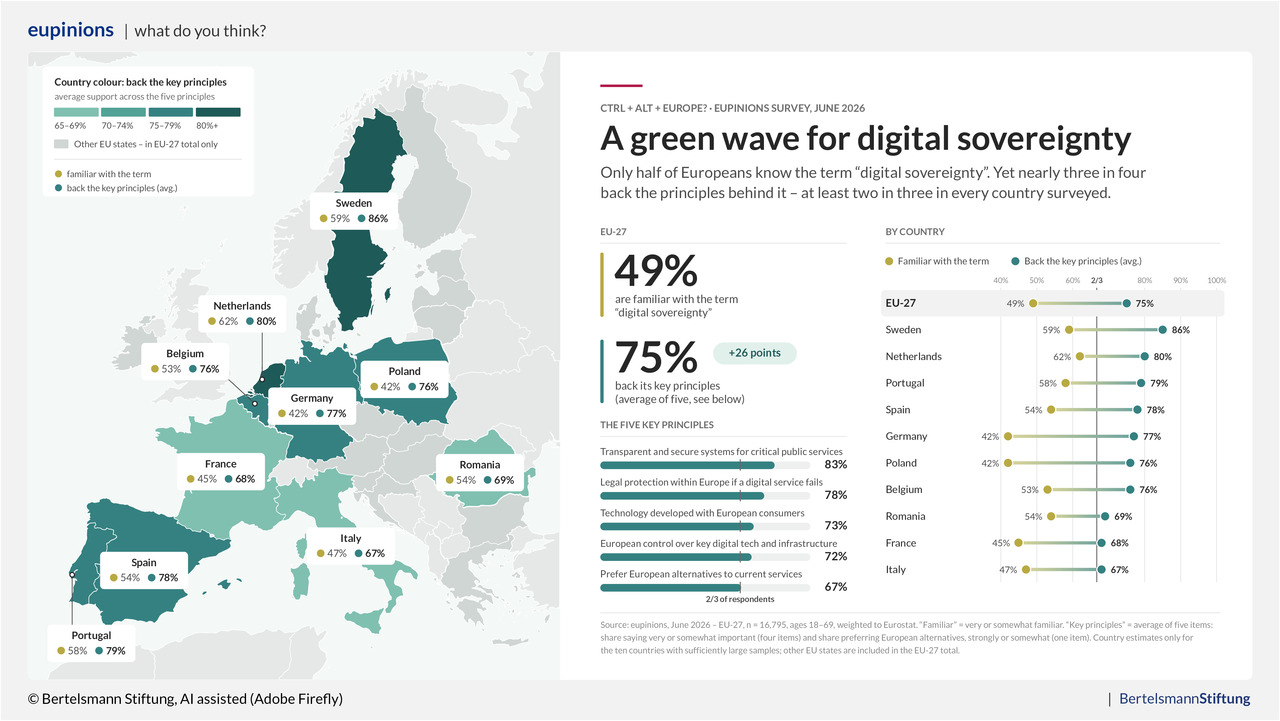
Viewed in the context of the other findings, the result is multi-dimensional (Figure 11). Most Europeans want greater control over their digital infrastructure and are concerned about losing that control to actors outside the continent. They can also articulate quite clearly what the necessary safeguards should look like: verifiable public-sector systems, effective legal remedies, and a say in the development of new technologies. Yet they are considerably less certain that the relevant institutions are capable of delivering these safeguards – particularly through the combination of regulation and the renewed push for strategic industrial policy to help build European capabilities. This is particularly noteworthy given that the past 15 years have been characterised by the so-called Brussels effect: the European Union’s ability to shape global standards through its stringent regulation of the single market. Because global technology companies generally have little incentive to develop entirely separate products for different regions, they may align their global practices with demanding European standards in order to retain access to the lucrative EU single market.
6 | Conclusion
This survey, conducted in June 2026, coincided with a period of intense debate about the issue of digital sovereignty. Ongoing shifts in the global geopolitical balance of power – and their implications for the digital services used in Europe – have made the consequences of technological dependence increasingly tangible.
Since Donald Trump’s re-election and the introduction of restrictions on US exports of the most advanced frontier AI models, the implications of digital dependence for Europe’s capacity to act and its competitiveness have become increasingly apparent. High-profile cases involving US sanctions against German activists from HateAid and, in particular, ICC judge Nicolas Guillou, have further illustrated the risks associated with one-sided dependence. After Guillou was involved in issuing arrest warrants for Benjamin Netanyahu and others, his access to services provided by US companies, including Amazon, PayPal and Visa, was restricted. In interviews, including with Le Monde, he described this a form of ‘digital erasure’ that left him feeling as though he had been ‘thrown back to the 1990s’.
At the same time, extensive media coverage of the ongoing AI transformation illustrates the extent to which digital issues now affect many different areas of people’s lives, from concerns about the impact of AI on labour market and the energy consumption of data centres to polarisation on social media. Digital issues are no longer the preserve of technology enthusiasts; digital infrastructure and services have become an essential foundation of our societies and economies.
Against this backdrop, public support for the fundamental principles of digital sovereignty is remarkably broad. It extends across all age groups and most of the political spectrum and remains high across differently framed questions. Particularly noteworthy is the fact that even a technically abstract issue such as digital sovereignty is considered highly relevant by a majority of respondents. The principles underpinning it enjoy broad acceptance among the European public.
At a time when decision-makers are strategically prioritising the development of European capabilities across the technology stack, however, the survey results should not be interpreted as presenting a choice between technological capacity and regulation. While a majority of Europeans remain unconvinced by Europe’s regulatory performance to date, they nevertheless support the development of new European technological capabilities and by no means reject further effective regulation. Rather than viewing these two approaches as opposites, respondents appear to regard technological capacity and effective regulation as complementary elements in reducing Europe’s digital dependencies.
At the same time, the strategic direction European decision makers take on the basis of these findings matters as much as the scale of investment. European alternatives should not merely mean replicating the centralised, proprietary hyperscaler paradigm that created today's dependencies in the first place.
A European response built on the same logic, with a handful of dominant, closed platforms, merely headquartered on the continent, would exchange one form of dependency for another while undermining the transparency, legal remedy and public control that citizens overwhelmingly demand. Europe's comparative advantage lies in a different architecture altogether: open digital commons, interoperable and federated systems, and decentralised infrastructures whose resilience derives precisely from not having a single point of failure and thus no remote switch to pull.
This approach also plays to Europe's genuine strengths at a moment of ongoing global uncertainty: the credibility of its regulatory framework, its tradition of institutional neutrality, and its dense network of public research institutions. Trusted infrastructure that is verifiable, jurisdictionally accountable and open to scrutiny is something Europe is uniquely positioned to supply, for itself and for partners beyond it.
Nowhere is this more consequential than for the architecture of scientific truth which is increasingly under pressure: open, reproducible research environments with cryptographic provenance for data, methods and models could become the European equivalent of a global public good, protecting the integrity of knowledge production in an era when both are increasingly contested. Framed this way, digital sovereignty is not a defensive retreat but an exportable and competitive proposition towards an infrastructure of trust for business and science, public administration and democratic discourse alike.
What is clear, however, is that Europe’s efforts to reduce technological dependencies still lack a compelling narrative and accessible, less technocratic terminology. The traction gained by concepts such as the Euro-Stack lends support to this view. At the same time, further work is needed to improve public understanding of the issues at stake. If this potential can be fully realised, digital sovereignty could develop into an issue with broad resonance across Europe, one framed not merely as a reactive response to external threats, but positively and proactively as a confident vision for a digital future more closely aligned with the common good.
About eupinions
eupinions is an independent platform dedicated to gathering and analysing data on European public opinion. We provide insights into what Europeans think about current political issues and emerging megatrends.
Every quarter, we conduct surveys across all EU member states in 22 languages. Our data is representative of the population in terms of age, gender and country/region.
eupinions is a Bertelsmann Stiftung project. The data is collected by Nira Data.
For more information, visit https://eupinions.eu!
Methodology note
The samples analysed in this report were drawn by Nira Data (formerly Latana and Dalia Research) across all 27 EU Member States in June 2026 (EU: n=16,795). The samples reflect current population distributions with respect to age (18-69 years), gender, education, and place of residence (city, town or suburb, or rural area). To obtain census representative results, the data were weighted using the most recent Eurostat statistics.
Any references to cross-country differences in this report are limited to ten countries with sufficiently large sample sizes: Belgium, France, Germany, Italy, the Netherlands, Poland, Portugal, Romania, Spain and Sweden.
The estimated overall design effect of the final European weights is 2.03. Accounting for this, the effective margin of error for EU-wide estimates is ±1.0% at a 95% confidence level.
The survey questions were developed through a co-design process in collaboration with members and experts from the European Network for Technological Resilience and Sovereignty (ETRS). We sincerely thank them for their support and contributed expertise.